
Industry first! Toray breaks through again
Polyphenylene sulfide (PPS), known as a "super engineering plastic," has seen steadily rising demand in automotive components and electrical/electronic applications thanks to its excellent heat resistance and chemical resistance. At the same time, as European resource-circulation regulations tighten, demand from the automotive industry and others for post-consumer recycled materials is rising rapidly, and PPS — a core automotive material — is at the forefront.
Yet it is precisely this "extremely strong chemical resistance" that has made PPS recycling a long-standing industry obstacle: almost no solvent can dissolve it, separating foreign matter from waste is extremely difficult, and until now no effective recycling process existed.
【DT New Materials】has learned that Toray of Japan has recently announced the development of a new solvent-based recycling technology — which, according to the company, is the industry's first process capable of recovering polyphenylene sulfide (PPS) from waste.
Conventional chemical recycling requires depolymerizing plastic down to the monomer level and then re-polymerizing it. Toray's method instead uses a polar organic solvent to selectively dissolve the PPS polymer in the waste at high temperature, while non-soluble foreign matter such as glass fiber is removed directly through solid-liquid separation. The dissolved PPS solution is then cooled, causing the PPS to crystallize and precipitate out in polymer form. The result is recycled PPS that retains its original molecular chain structure.
In other words, Toray found the right solvent system and process conditions, allowing PPS to dissolve within a specific temperature range and then precipitate out controllably upon cooling. More importantly, thermoplastic composites now have two recovery routes — "resin matrix recycling + fiber recycling" — making thermoplastic composite materials even more attractive.
Preliminary estimates indicate that the greenhouse gas emissions from this recycled PPS can be roughly 30% lower than those of virgin PPS. Toray has completed basic research and is currently carrying out a scaled-up demonstration project under Japan's Ministry of Economy, Trade and Industry (METI) 2024 fiscal year program, "Enhancing the Resilience and Autonomy of the Circular Economy System through Industry-Government-Academia Collaboration." The company plans to begin commercial supply by 2030 and will partner with partners in the automotive, recycling, and other industries to build a resource recycling system covering everything from collecting PPS-containing waste to the reuse of recycled PPS.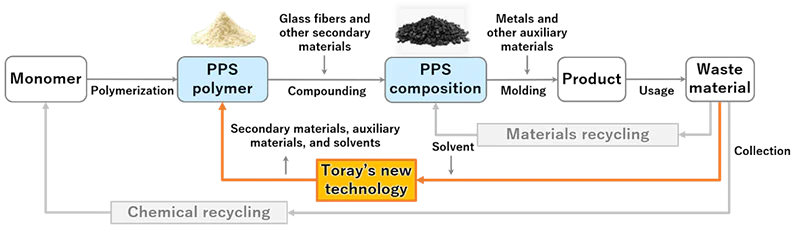
In fact, as early as October 3, 2023, Toray had already announced the development of a new technology enabling the recycling of glass-fiber-reinforced PPS (PPS-GFRP) with performance equivalent to virgin resin. By using its proprietary compounding technology to mix PPS resin with specially reinforced fibers, Toray developed pellets for recycled materials. When these pellets are blended with recycled materials, performance comparable to virgin material can be maintained, suitable for the same applications — such as horizontal recycling — with broad potential across many fields. 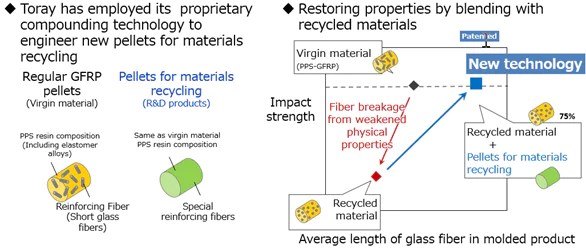
Beyond PPS recycling, in February of this year Toray developed the world's first PPS resin that simultaneously combines flexibility, flame retardancy, and high-temperature resistance, is PFAS-free, and costs less than fluororesin. Its long-term durable heat resistance reaches 185°C, its flame retardancy achieves UL94 V-0 rating, and its flexibility far exceeds that of conventional PPS resins and commercially available fluororesins — a well-balanced combination across every dimension.
In addition to technological breakthroughs, Toray is also leading in PPS production capacity. At the end of October 2025, Toray Advanced Materials completed the expansion of its second PPS production line at its Gunsan plant in South Korea, adding 5,000 tonnes of annual capacity. After the expansion, the plant's total PPS capacity reached 13,600 tonnes/year, making it South Korea's largest PPS production base. In parallel, Toray also expanded the capacity of sodium hydrosulfide (NaSH), a key PPS raw material, by 4,800 tonnes/year to strengthen cost competitiveness.
Furthermore, in June 2026, Toray announced that, through its Indian subsidiary, it would build its first in-house PPS composite material production line in India at Sri City, Andhra Pradesh, with a designed annual capacity of 3,000 tonnes and production planned to start in early 2027. Once completed, Toray's global total PPS capacity will rise from 33,600 tonnes/year to 36,600 tonnes/year. This is a key step in strengthening localized supply chains under Toray's long-term strategy, TORAY Challenges 2035.
Toray is not the only player — the domestic (Chinese) PPS sector is equally active.
On September 15, Binzhou Hengding New Materials Technology Co., Ltd. — the new materials project entity newly established by Befar Group — issued a solicitation notice for general construction contracting (excluding civil works) for a polyphenylene sulfide (PPS) specialty materials project, with a construction scale of 10,000 tonnes/year of PPS specialty materials production units plus byproduct salt refining and purification facilities.
Earlier, the 10,000 tonnes/year fiber-grade PPS new materials project of Shandong Befar Binyang Combustion & Chemical Co., Ltd., a leading domestic fiber-grade PPS producer, was officially commissioned on March 31, 2021. This time, Binzhou Hengding New Materials, under a brand-new entity, is undertaking the 10,000-tonne-scale expansion, extending the original fiber-grade product advantages into specialty materials — marking Befar Group's strategic upgrade in the PPS segment.
On September 9, Chongqing Jushi New Materials Technology Co., Ltd. published the environmental impact assessment (EIA) acceptance disclosure for Phase I (4,000 tonnes/year) of its 8,000 tonnes/year highly active crystalline-grade PPS resin digital-intelligent production line demonstration project. The plan includes two new 2,000 tonnes/year highly active crystalline-grade PPS resin production lines and one 2,500 tonnes/year PPS oligomer cross-linked product production line. After expansion, external sales of fiber-grade PPS products will decrease from 9,000 tonnes/year to 5,000 tonnes/year.
It is reported that the company plans to build a 30,000 tonnes/year PPS resin project. To date it has completed a 10,000 tonnes/year PPS resin production line, one 100,000 tonnes/year PPS cross-linked product pilot unit, and one PPS R&D test unit. Main products include 9,000 tonnes/year of fiber-grade PPS resin and 1,000 tonnes/year of injection-molding-grade PPS resin; byproducts include 1,000 tonnes/year of PPS oligomers and 16,810 tonnes/year of sodium chloride.
On September 4, NHU disclosed that its current annual PPS capacity is 22,000 tonnes, with 30,000 tonnes approved; the remaining 8,000 tonnes/year PPS capacity project is steadily progressing.
On August 17, the EIA report for the R&D center expansion and engineering plastics technology renovation project of Envalior Engineering Materials (Jiangsu) Co., Ltd. was publicly disclosed. The plan adds a new R&D line with 90 tonnes/year capacity, expands the R&D testing center by 2,260 m², and adds a new modified PPS product line with an annual capacity of 6,600 tonnes.
On May 6, the 160,000 tonnes/year PPS project of Jiangsu Dongtai Qixin Technology Co., Ltd. was signed and settled in Nantong, Jiangsu. The project is being built in two phases, with Phase I investing RMB 1.6 billion; when fully completed it will produce 160,000 tonnes/year of PPS material. Earlier, in August 2025, Dongtai Qixin had started an 80,000 tonnes/year PPS project in Huangshan, Anhui, with a total investment of RMB 1.6 billion. After both projects land, Dongtai Qixin's planned total PPS capacity will reach 240,000 tonnes/year, targeting the world's No. 1 position.
In February, according to Shangyu reports, the 20,000 tonnes/year composite PPS construction project of Envalior NHU Engineering Materials (Zhejiang) Co., Ltd. is being accelerated. The project is a joint venture between Envalior and NHU.
According to incomplete statistics, current global PPS total capacity is approximately 227,300 tonnes/year. Major producers include: Toray (32,600 t/y), DIC Corporation of Japan (23,000 t/y), NHU (22,000 t/y), Syensqo (20,000 t/y), Kureha of Japan (15,700 t/y), Celanese (15,000 t/y), HDC of South Korea (12,000 t/y), Chongqing Jushi (10,000 t/y), Shandong Befar (10,000 t/y), Tongling Ruijia (10,000 t/y), Shandong Minghua (5,000 t/y), Tosoh of Japan (5,000 t/y), and Changxian New Materials (2,000 t/y).