
50% Tariffs Take Effect: Canada Retaliates Against U.S. Plastic Products
According to foreign media reports, Canada has begun imposing 50% tariffs on six categories of U.S. plastic products and 15% tariffs on three types of plastic molds, with the measures taking effect on September 8. These products previously qualified for duty-free treatment under the U.S.–Mexico–Canada Agreement (USMCA) and had never been subject to tariffs.
The move marks a significant escalation in U.S.–Canada trade tensions. Just two weeks earlier, on August 22, the Trump administration imposed 50% tariffs on U.S.$27.6 billion worth of Canadian goods.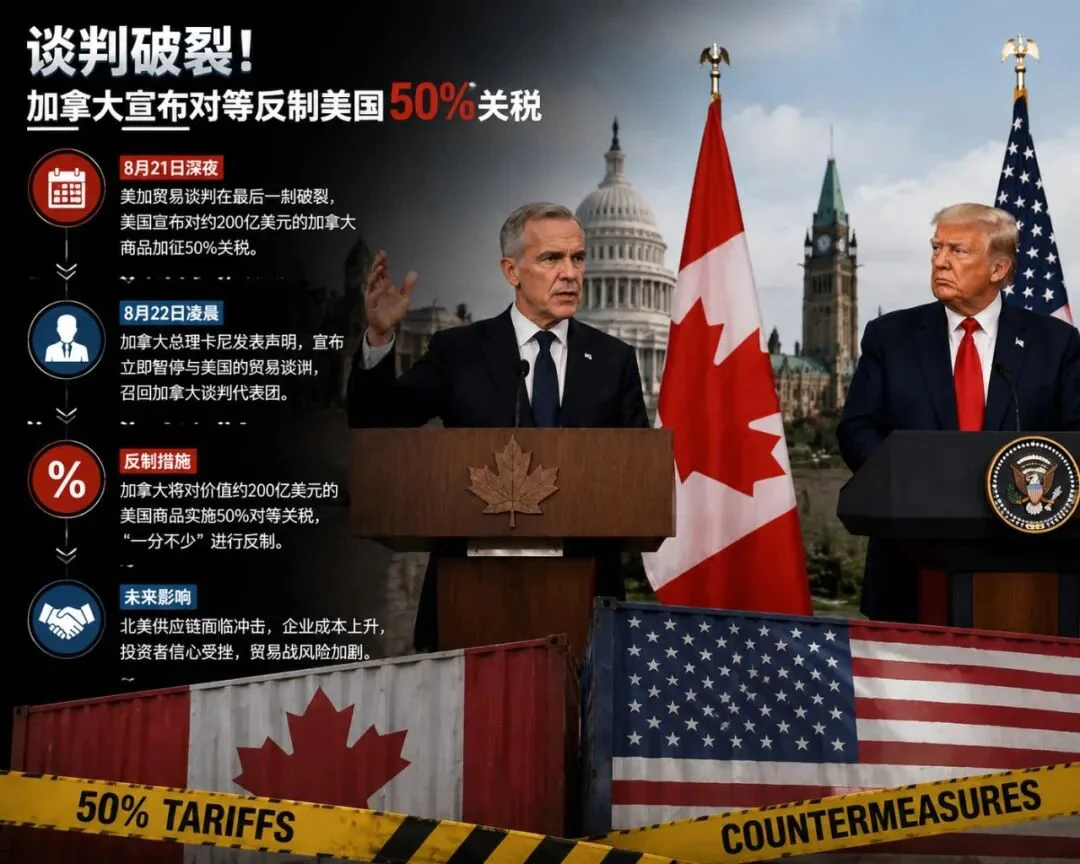
The Chain Reaction of the Trade War
The retaliatory tariffs announced by Canadian Prime Minister Mark Carney cover roughly US$20 billion in U.S. exports, with rates ranging from 15% to 50%. Canada will also raise its existing tariffs on U.S. steel and aluminum from 25% to 50%, matching U.S. rates.
Canada's new tariffs target hundreds of U.S. products, concentrated in dairy, home appliances, agricultural equipment, pulp and paper, plastics, and electronics. Among the U.S. goods facing 50% tariffs are milk, T-shirts, perfume, smartphones, and some furniture; those facing 25% tariffs include U.S. cheese, toilet paper, carpet, and some home appliances; and U.S. air conditioners and certain machinery parts face 15% tariffs.
The six categories of plastic products subject to the 50% tariff are:
■ Plastic bags of all kinds: including all types of plastic shopping bags, packaging bags, etc.
■ Packaging materials and containers: covering plastic packaging materials and containers used for food, consumer goods, etc.
■ Tableware: including disposable or reusable plastic plates, cups, spoons, forks, etc.
■ Kitchenware: such as plastic utensils and food storage containers for kitchen use.
■ Vinyl wall/ceiling coverings: PVC-based plastic wall or ceiling decorative materials.
■ Plastic household furniture.
Direct Impact on the Plastics Industry
In 2024, U.S. plastic product exports to Canada totaled US$8.07 billion, and in 2025 they reached US$7.78 billion; U.S. plastic product imports from Canada totaled US$8.34 billion and US$7.69 billion, respectively. The U.S. trade deficit with Canada in plastic products narrowed from US$270 million in 2024 to a US$90 million surplus in 2025.
Perc Pineda, chief economist of the Plastics Industry Association (U.S.), analyzed in an August 1 blog post: "In this context, given the relatively balanced bilateral trade relationship, the impact of tariffs on plastic products could be limited. But for plastic molds, tariffs could raise the cost of U.S.-made molds in Canada and further erode U.S. mold manufacturers' market share."
Pineda also noted that since the establishment of USMCA, Mexico has become the largest export market for the U.S. plastics industry, with the U.S. maintaining a trade surplus with Mexico. As of September 8, U.S. exports of plastic products and molds facing double-digit tariffs totaled US$946 million, accounting for 12.1% of total U.S. exports of related products to Canada in 2025.
Concerns of Canada's Plastics Industry
The Trump administration's 50% tariffs are causing concern across Canada's plastics industry. An official from the Chemistry Industry Association of Canada in Ottawa said in August: "For Canadian manufacturers affected by the new tariffs, competitiveness is the pressing issue."
Canada's plastics industry holds a significant position in both North American and global supply chains. Backed by abundant oil and gas resources, its upstream polyolefin industry enjoys a cost advantage. In 2024, total demand in Canada's plastic products market reached US$31.9 billion, ranking eighth among 20 major developed countries. The industry comprises about 3,092 manufacturers, with an industry profit margin of 9.8%, ranking tenth among developed countries. More than one-third of output is destined for international markets, with the U.S. as the overwhelmingly largest export destination — a reflection of the industry's strong reliance on international markets.
In upstream resins and basic chemicals, NOVA Chemicals is the undisputed leader. Founded in 1975, the company is currently Canada's largest producer of ethylene and polyethylene, with about 2,600 employees worldwide, 90% of them in Canada. Its 2024 sales were approximately US$3.6 billion. Its polyethylene technology is widely used in packaging, infrastructure, and consumer goods. In recent years it has also invested in a globally leading mechanical recycling facility in Indiana, U.S., and launched the SYNDIGO™ recycled polyethylene product line.
Canada's plastics equipment industry is worth about US$2.8 billion, growing at roughly 4.5% annually, and has nurtured a number of globally influential companies. The leading firm, Husky, was founded in 1953 and is headquartered in Bolton, Ontario. It is a world-leading supplier of injection molding equipment, with products covering injection molding machines, hot runner systems, robots, and molds, and operates multiple manufacturing bases around the world.

Mold-Masters was founded in 1963 and is headquartered in Georgetown, Ontario. It is a pioneer in hot runner technology, holds more than 900 patents, and serves customers in over 100 countries.
Macro Engineering was founded in 1978 and specializes in blown film and cast film extrusion systems, capable of producing multi-layer film lines of up to 13 layers.

In the downstream plastic products sector, Royal Group Technologies is Canada's largest manufacturer of plastic products. In addition, Canada has a number of regionally competitive small and medium-sized enterprises in niches such as automotive plastic parts, plastic pipe for construction, and plastic components for medical devices.
The Trade War Escalates Further
One day before Canada's new tariffs took effect, Trump threatened to impose 50% tariffs on Canadian automobiles and auto parts, effective January 1, 2027. Trump also threatened Canadian aerospace manufacturer Bombardier, saying the company would need to establish manufacturing operations in the U.S. to maintain access to the American market. Trump further floated the possibility of excluding Canadian companies from the "multiple award schedule" program — a procurement vehicle used by government agencies for IT and office supplies, which covered US$50 billion in purchases last year.
Canada's border cities are feeling the impact of the trade war particularly acutely. Mike Bradley, mayor of Sarnia, Ontario, said the trade dispute would be a "job killer" for his community. The city is a major exporter of plastic products — precisely one of the product categories targeted by the latest U.S. tariffs.
Canadian manufacturers will face pressure from rising costs on both molds and plastic products. The 15% mold tariff and 50% plastic product tariff further escalate the U.S.–Canada trade war, and Canadian manufacturers will face significant cost increases for critical production equipment and plastic goods.
The tariffs could disrupt procurement decisions, increase compliance burdens, and prompt manufacturers and distributors to reconsider established U.S.–Canada supply chains.
Chinese Plastics Companies Shouldn't Just Be Bystanders
For Chinese plastics companies across the Pacific, this Canada–U.S. tariff war is not unrelated to them. In fact, there is a trade link between Chinese plastics firms and the Canadian market that cannot be ignored — in 2025, Canada imported a total of US$3.26 billion in plastic products from China, while Canada's plastic product exports to China reached US$479 million. This means the tariff standoff between Canada and the U.S. could, through supply chain transmission effects, indirectly affect the pace and pattern of China–Canada plastics trade.
Canada's tariffs on U.S. plastic products will inevitably raise prices and reduce the competitiveness of some U.S. plastic goods in the Canadian market. This objectively opens up space for Chinese plastic products to enter the Canadian market. At the same time, however, Canada also launched an anti-dumping investigation into Chinese PET resin in 2025, with the final ruling determining a dumping margin as high as 100.6% for Chinese exporters. This shows that opportunities and barriers often appear simultaneously — while seizing the window, Chinese plastics firms expanding into the Canadian market must also be wary of trade protectionism's "targeted strikes."
For Chinese companies, the Canada–U.S. tariff war is a mirror — it reminds us that in an era of normalized trade frictions, the ability to maneuver across multiple markets, and the ability to optimize production capacity and supply chain layouts globally, will determine the long-term competitiveness of both companies and industries.