
Plastics Divergence: Upstream Rakes It In, Midstream Gets By, Downstream Bleeds—Who Can Ride It Out?
 The 2026 interim reporting season has closed, and the plastics industry chain has presented a dramatic picture of stark contrasts: some companies saw net profit surge more than tenfold, some doubled their profits in a sprint, while others lost over 100 million yuan in a single half-year. What industry logic lies behind this sharp polarization? And who is quietly staking out the next growth frontier?
01 One Reporting Season, Three Very Different Fortunes
The "uneven heating and cooling" across the plastics industry chain is vividly reflected in this year's interim reports.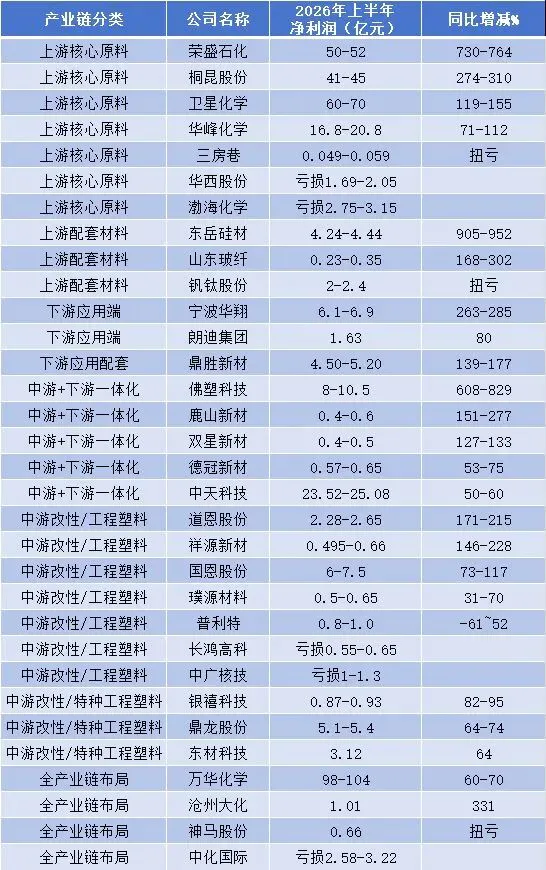
Upstream refining and chemical companies are the big winners of this cycle. Benefiting from the pass-through of crude oil cost pressure down the chain, many companies posted net profit growth of tenfold or more, with some approaching the tenfold mark. Industry statistics show that among 32 listed companies across the full plastics value chain that have disclosed interim earnings pre-announcements, one company recorded a maximum year-on-year net profit increase of 952% — the pricing power of resource-end players has been amply demonstrated in this round.
Midstream modified plastics companies show a "the strong get stronger" pattern. On one hand, several leading players have doubled profits, with the fastest-growing exceeding 180%, and processing spreads for high-end modified and automotive-grade compounds sitting at the 50th–60th percentile of the past three years. On the other hand, in the 353-billion-yuan modified plastics sector, the combined revenue of the top ten companies reached 65.6 billion yuan — yet only four of them broke the 100-million-yuan net profit mark. On the same track, the gap in earning power between companies is widening.
Downstream plastics products manufacturers have become the ones bearing the pressure. At least one company posted a first-half loss exceeding 100 million yuan, swinging from profit to loss. Processing spreads for general-purpose modified PP sit at a low 20th–30th percentile of the past three years, and some small and mid-sized plants are approaching the break-even line, squeezed from both sides by high raw material costs and limited room to raise end-market prices.
02 The Deciding Factor Behind the Divergence
Everyone is in plastics — so why do some eat the meat while others take the beating? Industry analysts argue that two breakthrough paths lie at the heart of this divergence:
Vertical integration that locks in costs. Some high-performing companies have extended their industrial chain and moved into upstream raw material segments, locking in a cost advantage amid volatile bulk raw material prices and converting uncertain risk into a certain profit margin.
Premiumization — shifting from selling on price to selling on certification. Competition in the general-purpose materials market is becoming increasingly cutthroat, with excess low-end capacity and intensifying price wars. High-end modified materials, by contrast, command strong pricing power and cost pass-through capability thanks to high technical barriers and long certification cycles. This also explains why, within the same midstream segment, companies focused on high-end products are doubling profits, while processors focused on general-purpose materials are struggling at the break-even line.
03 Where Is the New Engine? AI, Robotics and New Energy
If "cutting costs" is the defensive strategy for holding the base business, then "finding new growth" is the offensive play that lifts the ceiling. The ramp-up of emerging industries is opening new headroom for high-end materials. Demand for high-performance modified plastics continues to climb in AI servers, humanoid robots, the low-altitude economy, and new energy vehicles, becoming the key driver pushing the industry toward higher-value segments. Companies that have already positioned themselves in these tracks are enjoying the "structural dividend" brought by emerging demand.
For example, in new applications such as new energy vehicles and smart homes, demand for modified engineering plastics has risen markedly; while frontier fields such as AI servers and robotics place higher requirements on heat resistance, flame retardancy, and lightweighting — forcing companies to shift from "competing on capacity" to "competing on technology".